
|
|
Hip FracturesThe acetabular joint, or hip joint, is the largest ball and socket joint in the body. When a break or crack in the bone occurs in the femur or acetabulum (hip bone) it is called a hip fracture, or broken hip. ![]() A hip fracture commonly occurs in the elderly during even a seemingly harmless fall when the hip bones are weakened (i.e. in the case of osteoarthritis) and often requires hospitalization. A fracture may also be caused by a hard hit in a car accident or during a sporting activity. Fractures and hip dislocations often occur together. A fracture in the hip can refer to a break in the femoral head or to the hip socket itself. The degree of fracture can range from a small (grade 1) fracture, to a serious (grade 4) fracture. Fractures to the femur are categorized as femoral neck fractures or intertrochanteric hip fractures. Femoral neck fractures affect the area just below the femoral head (top of thigh bone). Besides the fracture of the bone, damage to the arteries leading to the femoral head is another concern as it can limit the necessary blood supply. Without healthy blood flow delivering the necessary nutrients and oxygen, complications such as hip osteonecrosis (also called avascular necrosis) can result. Osteonecrosis can lead to the bone marrow dying, weakening the femoral head and leaving it at risk of collapsing. Repairing the fractured bone and arteries is important to maintain the blood flow to the head of the femur. Intertrochanteric hip fractures affect the area well below the femoral head, and as a result, are much easier to heal. This is because the fractured area is easier to treat because of its location, and blood supply to the bone is not as much of a concern. Symptoms of a Hip Fracture
Risks and Causes of a Hip Fracture![]()
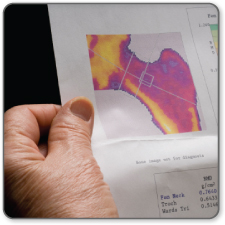
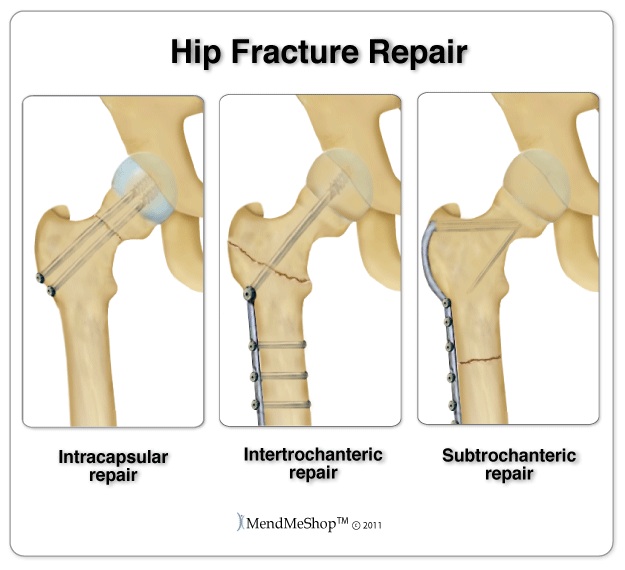
Tests for Hip FracturesYour doctor will perform a physical exam and request an x-ray to diagnose a hip fracture and determine the type of treatment that you need. Your doctor may do an MRI to see if there is additional damage to the soft tissue of the hip that requires treatment. Surgical ProceduresHip fractures almost always require surgery. The type of surgery will depend on the severity and location of the fracture as well as the age of the patient. A hip replacement may be performed with patients over 60 years of age who are less active. Hip replacements tend to wear out in more active patients so they are generally avoided in younger and more active elderly patients. Femoral Neck Hip FracturesA procedure called hip pinning involves placing several screws across the fractured femoral head. It is usually only done in younger patients, or in the case of the fractured bone being well aligned. Even when this procedure is done properly, a partial or full hip replacement may be necessary in the future. Intertrochanteric Hip FracturesIntertrochanteric hip fractures are usually repaired with surgery by adhering a metal plate to the shaft of the femur with several small screws. X-rays are used to get the proper alignment, and then an 3" incision is made. The surgeon will affix the metal plate along the length of the fracture, and secure it with screws. ![]() Hip HemiarthroplastyHip hemiarthroplasty is a term that describes a partial hip replacement. The surgeon removes the femoral head and replaces it with a metal "ball" that will sit in the hip socket. This procedure is required when the hip fracture is especially mis-aligned or severely fractured. Treating a Hip FractureUsing cold compression and Blood Flow Stimulation Therapy (BFST®) before surgery will help to reduce the symptoms of pain and inflammation and help to improve the flow of blood to the bone and hip joint. These therapies will help to keep the surrounding tissue as healthy as possible. This is important for 2 reasons. First, with less inflammation and healthier tissue in the joint, the surgery will be less invasive and will require less time to heal. More importantly, it will minimize your risk of suffering future hip conditions such as arthritis, osteoarthritis, bursitis (a common condition immediately following surgery due to irritation during the procedure) and other chronic hip conditions. Cold compression therapy will help reduce pain and minimize the amount of damage that occurs to the tissue in your hip joint. Once inflammation has been reduced, BFST® will increase the amount of nutrients and oxygen that reach your bone to reduce the risk of osteonecrosis. Freezie Wrap® Cold Compression TherapyWithin the first 72 hours of a hip fracture and following surgery, cold compression therapy is recommended to reduce pain, swelling and tissue damage. In addition, on-going cold compression treatments can reduce, or even eliminate, the need for NSAIDs that can be harmful to your body. ![]() The Back/Hip Freezie Wrap® is the cold compression tool you need to treat your hip in an effective and convenient way. It is so versatile you can also use it to treat any pain you may be experiencing in your back or legs as well. The Back/Hip Freezie Wrap® uses a supercharged cooling gel pack, that chills in the fridge, not in the freezer like ice or other freezer packs, giving you deep cold therapy without the risk of 'cold burns' or cryoburn. The medical-grade wrap delivers cold right where you need it. Cold compression therapy works by interrupting and slowing nerve and cell function in the injured area and reducing swelling that can block blood vessels. This is important because once blood vessels are blocked or damaged, they can no longer carry oxygen and nutrients to your hip and tissue cells begin to break-down. Without cold compression therapy, cellular break-down and tissue damage continues as the cells do not get the oxygen they need to survive. By limiting the amount of damage done to your tissue, you limit the amount of healing that needs to occur. This is a very important step to heal your hip faster and with less pain! Inferno Wrap® Blood Flow Stimulation TherapyOnce the inflammation in your hip has been reduced, nourishing and strengthening your hip, lower back, upper leg and surrounding tissue is recommended. Using blood flow stimulation therapy will speed your recovery and heal your acetabular joint more completely preparing it for strengthening exercises. Talk to your doctor or physical therapist to find out which exercises are appropriate for your situation. ![]() When you stop moving your acetabular joint because it is fractured the blood flow to the hip is reduced, limiting your body's natural ability to heal itself. When a fracture occurs, the blood supply can be affected if there is damage to the veins and arteries. Correcting this problem is essential to prevent weakening in the femoral head. Increasing the amount of blood to the femur or femoral head is essential to heal the damaged bone, tendons, ligaments, labrum and articular cartilage. By treating your hip joint with BFST® you can increase your body's blood supply to the hip and increase your body's natural healing power. A Back/Hip Inferno Wrap® is the tool you need to treat your fractured hip and surrounding tissue because it speeds healing and relaxes the surrounding muscles, reducing your pain. With BFST®, tissues are safely and gently stimulated. Your body responds with a rapid increase in blood flow to the area, increasing the supply of oxygen and nutrients to injured tissue cells to promote healing. The Back/Hip Inferno Wrap® from MendMeShop® provides effective, non-invasive, non-addictive pain relief and healing with no side effects. In addition, the improved blood flow helps reduce the risk of atrophy in your muscles. When you stop moving your leg and hip due to pain, your muscles and other tissue can become weaker and dead cells and toxins in the area can cause further tissue deterioration - this can lead to atrophy in your quadriceps, hamstrings and other leg muscles. The Back/Hip Inferno Wrap® can also be used to treat your back, leg and other body parts with BFST®. It is an amazing healing tool that can be used to treat your entire body. By clearing the area of toxins and increasing the amount of oxygen and nutrients to your muscle and tendon tissue, the risk of atrophy (muscle weakness and/or deterioration) is greatly reduced. Keeping your upper leg and hip joint tissue as healthy as possible throughout the healing process will allow you to improve hip strength again once your pain has gone and your injury has healed. Ultrasound TherapyUltrasound therapy is not recommended for use while the bone is fractured or over any type of surgical implant. However, it can be used with your doctors permission, once the fracture has healed if no implants or screws were used during surgery. Ultrasound therapy helps increase the range of motion in your joint, reduces post operative scar tissue and increases flexibility in the surrounding muscles, tendons and ligaments. Ask your physical therapist and/or doctor about ultrasound and if it's right for your recovery! ![]() Once the fracture has healed, ultrasound therapy is a great therapeutic option to increase tissue elasticity or the tendons and ligaments while slightly increasing blood flow to your hip joint. This cleans the injured area by flushing away damaged tissue and reducing the inflammation while opening up the blood vessels to begin healing. Not only does ultrasound aid in the duration of healing, but it helps to prevent long term complications. Osteoarthritis, chronic pain, reduced range of motion, and bursitis are some of the more common long term complications that can occur when hip injuries go untreated or following hip surgery. By treating your acetabular joint with ultrasound, scar tissue becomes softer and the other joint tissue becomes stronger reducing the risk of chronic problems in the future. If you are experiencing pain in your back, knee, ankle or leg because of your hip injury, you can use therpeutic ultrasound to treat these areas as well. With hip injuries you often readjust your posture and gait to take the pressure off your sore side. This puts extra pressure on other parts of your body and can cause strain. Using a home ultrasound will allow you to treat all the areas that need to heal easily and help you maintain a healthier body. During the healing process, scar tissue builds up to 'repair' the damaged tissue. Unfortunately, scar tissue can bind the acetabular labrum, articular cartilage, ligaments and other tissue together within the joint. The inflexible scar tissue limits the movement of these connective tissues that were once elastic and gave your hip its stability and range of motion. As a result, movement of the entire joint is limited making it difficult to rotate your hip and lift your leg. If scar tissue is left untreated, your hip may stiffen making movement difficult and in some cases, impossible. At the very least, scar tissue leaves your hip joint weaker, making your hip more prone to further injury. Fortunately, you can treat your hip joint with MendMeShop® Ultrasound to soften scar tissue and improve the motion and flexibility in your hip. Ultrasound can also be used to administer therapeutic medicines into the body. This is a process known as phonophoresis. Ultrasound with phonophoresis is rapidly becoming more popular than ultrasound therapy alone. ![]() MendMeShop® ultrasound therapy with phonophoresis is safe, convenient, and easy and requires 10 minutes per treatment. It is based on a form of deep tissue therapy, which is generated through high frequency sound waves (that we can not hear). These waves send micro vibrations into your body and carry medicated molecules within the ultrasound gel deep into your soft tissue to enhance your ultrasound therapy. Ultrasound waves and medicated ultrasound gel penetrate deep to relax your muscles, decrease inflammation and accelerate your recovery rate, so you can return to your daily activities as soon as possible. Using MendMeShop® Lavender Infusion Ultrasound Gel during your ultrasound therapy gives you 2 therapies in 1. You get the benefit of the regenerating sound waves from the ultrasound device itself AND the added bonus of the therapeutic ingredients inside the gel being delivered into your hip joint where it is most effective. 1 FREE bottle of MendMeShop® Lavender Infusion Ultrasound Gel comes with every MendMeShop® Ultrasound Therapy System and it contains the therapeutic essential oils of natural Bulgarian lavender, peppermint, eucalyptus, and menthol. Would you like to discuss Hip Fractures or other | Hip Injury Facts: Over 90% of hip fractures are caused by falling, most frequently on the side of the hip. Less than 50% of hip fracture patients return to their former level of activity. Proper treatment is important to maintain strength and range of motion. Hip alignment affects the pressure put on the knees. A hip disorder can aggravate knee pain and vice versa. 1 in 7 Americans, over the age of 60, reports significant hip pain. In most cases, arthritis pain will not benefit from a hip arthroscopy. 70% of non-fracture hip replacements in 2003-2004 were to treat osteoarthritis. Dear MendMeShop, I played basketball in college back in Connecticut and now am 43 and trying to get back in to shape and back on the basketball court for about 2 years now and couldn't b/c of the adhesions. All is slowly getting better. I've been using the ultrasound device for about 3 weeks now and was able to play my first basketball game with out my calf muscle adhesions acting up. I was doubtful but hopeful at first but I now see it actually works! Thanks again. Rating: Eric Tetrault Dear MendMeShop, Thank you for your professionalism I also appreciate your knowledge of your product and the links to the other sites. As far as the efficiency of your product, I agree that yours has the best rating. In fact, I am a physical therapist, and was really looking to purchase a unit that has continuous/thermal effects for home, but was unable to find one at a decent price. Even used! I do like the three settings on your product. I purchased it for my fiancee who has tightness in his rhomboids especially, but low back pain as well as traps. He has responded well to US in the past and has an interferential unit and TENS unit as well. He has been for PT, Chiropractic and massage therapy. So I was very happy when he reported relief from your product even after the first treatment! I myself, have SI joint dysfunction, tight upper traps, as well as wrist pain due to torn ligaments. The unit is not quite as effective on me...I do better with Continuous. But, it does loosen my low back up enough prior to stretching, as well as my traps prior to massage and stim. More recently, I am trying to see the effectiveness on my wrists as the torn ligaments are a result of overuse as a PT for many years. I am trying to avoid surgery as most of them aren't very successful for this type of injury. I will have to have surgery if the pain gets intractable or if arthritis sets in. At this point I am hoping the US, PT, paraffin, splinting, rest, and some other alternative treatments will buy me some time. Anyway, thanks again for your professionalism and I will recommend the unit to other therapists who may do home health, or for personal use. You are welcome to use any of my comments as a testimonial if you like. Rating: Lori Stillerman ![]() Dear MendMeShop, For over six months, I suffered from bursitis of the left hip. Nothing seemed to help. If anything, it was getting worse. Finally, my doctor gave me a prescription to see a physical therapist. A week before my first appointment I started using the hand held ultrasond that I received from MendMeShop. I started feeling relief. I was thrilled, and mentioned it to my therapist when I went for my first session. She said I was the third patient of hers that had purchased the ultrasound. She was getting good feedback, and asked if I would bring it in to show her. When I did, she was impressed. She also said the gel used with it, is the same high quality used in their clinic. I went ahead with a brief series of therapy treatments. I was discharged with some exercises, and told to continue to ice and use the hand held ultrasound on my hip. I have done that and I now feel that, between the icing and the ultrasound, my bursitis is being kept at bay! Another interesting thing I would like to share. I have a life long neck problem. I had a serious fall as a child, and as a result the first vertebre in my neck (the atlas) often becomes dislodged. When this happens, I become spacey and depressed and barely able to function until I can get to my upper cervical specialist in Chicago. Recently, while in Florida, I began to get the usual negative symptoms of my neck being out of allignment. I panicked. I couldn't fly back to Chicago for a treatment. I was terrified I would be miserable and my trip ruined. Out of desperation I used the ultrasound (on the low setting) on my neck. It felt wonderful, and the negative symptions subsided. I am still in Florida and doing fine. Very anxious to share this with my doctor in Chicago when I return. Rating: Sharon Carr ![]() ![]() ![]() ![]() ![]() ![]() ![]() |